
[homepage] - [ history ]- [ Français ] - [ Deutsch ] - [ Español ] - [Nederlands] - [ Italiano ]

October 17
1999


"Children want a world where everyone counts. Let's join them saying no to poverty".

The International Children's Forum

Discover in which ways this day was marked around the world : Worldwide agenda.

You can find the messages received during the day in the section : Messages of Support, Official Appeals and Statements for the World Day

Central event which took place on the Human Rights Plaza, Trocadero, Paris


return top

On the occasion of the 10th anniversary of the Convention on the Rights of the Child.

"Children Share Their Understanding of the World.
In the eyes of children who grow up in poverty the world is not evil or closed off to them. Their instinctive feelings tell them that no one is truly bad. They know that people do not really want war, torture, hunger or injustice. These children love the world because they understand it with their hearts. They love us, too, in the same way and that is why we cannot let any child down or leave them without friends. That is why we cannot let a single child or family go unloved."

Joseph Wresinski,founder of the International Movement ATD Fourth World

Children's International Forum ( document )


Return


The Children's International Forum on November 20, 1999

Making known what children are saying and doing, ATD Fourth World is organising a worldwide children's forum which will publicly acknowledge what children say about rights and the efforts they make to have these rights respected. This event will celebrate the 40th anniversary of the International Declaration of the Rights of the Child and the 10th anniversary of the adoption of the International Convention on Rights of the Child.

Return

The Forum as part of a wider story
20 November, 1959 - The adoption of the International Declaration on the Rights of the Child.
1979 International Year of the Child
20 November, 1989
- The Convention on the Rights of the Child.
1996 International Year for the Eradication of Poverty.
1999 - International Children's Forum

Return

"Special Stones": A worldwide campaign
Tapori wanted to make a contribution to the International Year for the Eradication of Poverty (and the Decade for the Eradication of Poverty 1997-2006), so they invited children to send in a pebble that could fit in an envelope and to include a message about their own life, the life of other children and what they do in their own way to "add their stone" to the foundations of a better world.

Return

The "Pathway of Special Stones"
This Pathway of Special Stones was inspired by the messages sent by the children and was created together with families living in persistent poverty.
This pathway will be inaugurated by Mrs. Mary Robinson, UN High Commissioner for Human Rights, in front of the Palais Wilson in Geneva on 20 November 1999, the 10th anniversary of the adoption of the Convention on the Rights of the Child.

Return

A Gift Given by the Children
Another sculpture, the centre-piece, will be created in Switzerland together with families living in poverty, Tapori children, friends and ATD Fourth World volunteers. This sculpture will be erected permanently at the Palais Wilson in Geneva, Switzerland, the home of the Human Rights Commission and the UN Committee for the Rights of the Child. The children who participate in the International Children's Forum will present the sculpture to Mrs. Robinson. This sculpture will be the last object on the path. It is inspired by a "Special Stone" with a hole in the middle of it.

Return

A Book of Children's Stories.
An illustrated book entitled My Heart is in this Stone, is to be launched at the International Children's Forum in November and will tell the story of the stones in the "Pathway of Special Stones." Noldi Christen, the author, is a full-time, long-term volunteer with ATD Fourth World and works at the international Tapori Centre.
This book will be published in four languages: (English, French, Spanish and German.)

Return

You can contribute to the campaign

"Friendship Triumphs Over Poverty," children can discover the lives and activities of other children worldwide. They can also make their portrait and write a message to show their support for the International Children’s Forum and send them to Tapori.

Return


return top

World Events
October 17th 1999


return Worlwide Agenda

America


United States of America

Washington:
October 15-17, 1999 there is a Tapori National Children's Assembly.
On Sunday October 17, 1999 from 11-4pm there has been a children's festival and commemoration on the West Front Terrace of the US Capitol building in Washington DC. The commemoration took place at 3pm.
Contact name: Jill Cunningham, 301-336-9489 email: fourthworld@erols.com

New York:
October 15, 1999 at 12:45-1.45pm there was a commemoration held in the gardens of the United Nations.
Contact name: Diana Skelton,
tel: 212 228 1339 email: fworld@mail.idt.net

New Orleans:
October 17, 1999, at 5pm there was a commemoration at Our Lady of Lourdes Center, 2401 Jena Street (behind Lourdes Church), reception followed.
Contact name: Angela Evosevic, tel: 504 899 9950

North Carolina:
East Chapel Hill High School Amnesty Club, in the Raleigh-Durham metropolitan area has been putting on a commemoration at their school.

Chicago:
October 12, 1999, Evangelical Lutheran Church in America (Chicago)
planned to have a chapel service which has included the World Day to Overcome Poverty.
Contact person: Tina Dabney, tel: 1800 638 3522 ext 2863 fax 773 380 2707

Boston:
October 17, 1999, contact person: Bruno and Genevieve Tardieu.
tel:617 783 7297 email: fourthworldboston@worldnet.att.net

Madison, Wisconsin:
There has been a commemoration: contact person James Hutchins, tel: 608 271 8240 email: jchutchins@students.wisc.edu

Appalachia:
October 17, commemoration with music, songs and readings at 5pm at Binns Counts Community Center, Nora, Virginia -it was followed by a pot-luck supper:
Contact person: Vincent and Fanchette Fanelli, tel: 540 835 1540
email:
vfanelli@compunet.net

return


return Worlwide Agenda

Europe


International Day for the Eradication of Poverty in:

Footballers Against Poverty


Great Britain


International Day for the Eradication of Poverty

This year will see the seventh UN International Day for the Eradication of Poverty and there are a number of important events taking place around Britain to mark the day. Please join in or organise your own local event. Here are a few examples:

Trafalgar Square, London

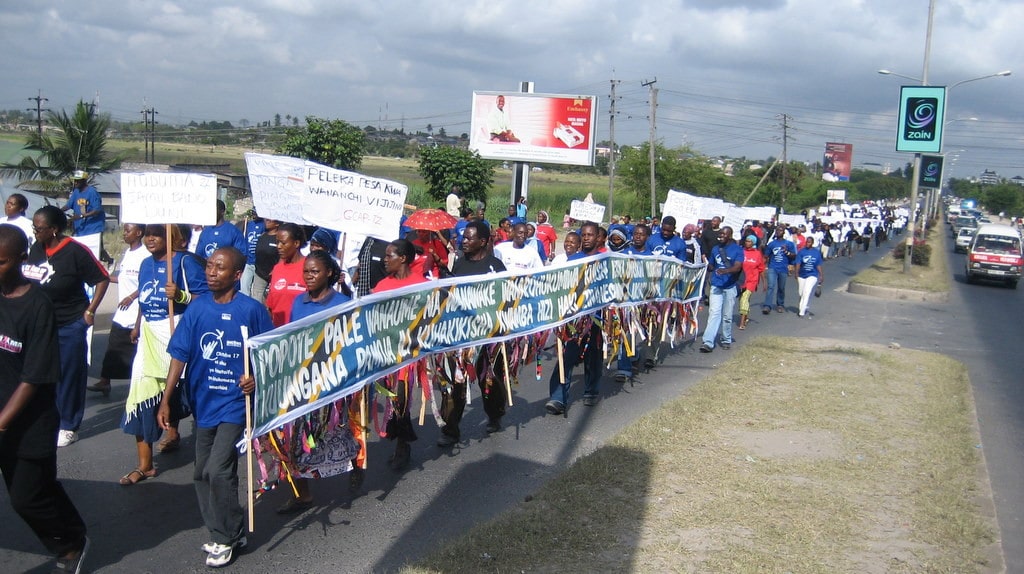
Walk from Lambeth Palace to Trafalgar Square has culminated in a public service in St Martin in the Fields (3pm). Organised by Church Action on Poverty and supported by ATD Fourth World.

Contact CAP on 0171 932 1263

Nationwide: "Pilgrimage Against Poverty"

Church Action on Poverty are making a "Pilgrimage Against Poverty"; a nine week walk across the length of Britain culminating with major events on the 16 and 17 October in London, Edinburgh and Cardiff.

Contact CAP on 0161 236 9321

Jersey

Jersey will be holding elections on 20 October and again in November. The Pastoral Centre has offered workshops on 17 October, 3pm - 6pm, run by media professionals to encourage people living in poverty to speak at election hustings.

Contact Karen Blampied on 01534 874008

Plymouth

A public display of prose and poetry written by people with direct experience of poverty was planned by Communities Against Poverty (Devonport) with support from Plymouth City Council.

Contact Karen Dugdale on 01752 564 945

Glasgow

In St George's Square, Glasgow Braendam Link together with Glasgow City Council has unveiled a Commemorative Stone to the Victims of Poverty based on the design found at the Plaza of Liberties and Human Rights at the Trocadero in Paris. This is a tremendous achievement and of great significance for the whole of Scotland.

Contact Elaine Downie or Maria Morrison on 0141 418 0000

The UK Coalition's "Voices For Change" project has been hosted by Scottish Poverty Alliance. Other events were planned.

Contact Kathy McCormack or Jane Jones on 0141 353 0440.

Thornhill, Stirling

A sponsored walk has taken place from the unveiling of the stone in St George's Square, Glasgow, to Braendam Family House in Thornhill. At Braendam, a plinth bearing an inscription dedicated to families living in poverty has been laid.

Contact Jonny or Roz on 01786 850 259

Liverpool

Communities Against Poverty are organising a conference on poverty to be held at Liverpool Town Hall, on Friday 15 October.

Contact Gerry Cochrane on 0151 255 0805

Hull

A silent march has been be organised starting from Wilberforce House, Britain's first anti-slavery museum, and stopping at different symbolic places.

Contact Paul Burkitt on 01482 343 182


Footballers Against Poverty

The main focus of our efforts for 17 October this year was the "Writing Off Poverty" postcard campaign. Since its launch last year thousands of people have sent postcards to Tony Blair asking him to declare 17 October 2000 as the first annual National Day for the Eradication of Poverty.

The Department of Social Security has been replying, on behalf of the Prime Minister, to every postcard sent since last October. Recently we have noted a much more positive response: "...your suggestion to declare 17 October 2000 as the first annual National Day for the eradication of Poverty, is interesting and is currently being considered."

To follow up this wonderful start to the campaign many friends have been contacting their local football clubs in order to get their backing for a "Footballers Against Poverty" Week. The week of 11-17 October saw the football teams of major clubs up and down the country lending their support to the campaign. So far, Liverpool, Everton, Tranmere Rovers, Wimbledon, Charlton Athletic, Sheffield United, Hull City and Leyton Orient have all agreed. Teams have signed huge "Write Off Poverty" postcards. The postcards have then been delivered by hand to Downing Street by a delegation of families and football players around Sunday 17 October.

Having football clubs involved with the campaign will really emphasise the spirit of 17 October; it should be a day when people from all walks of life can unite to show their solidarity with the most vulnerable members of society and reaffirm their commitment to eradicating poverty. Football is after all the people's game with an appeal that cuts across social boundaries. For the game to support the campaign would bring home the message that poverty is not just the concern of politicians, voluntary organisations or professionals, but the concern of every member of society.

There is still time to get involved. As well as writing to your local football club to ask them to endorse the campaign you can also take other forms of local action like putting up posters in public places, seeking the support of your religious community, lobbying local politicians and contacting your local press. Remember that every card distributed will help to raise awareness of 17 October and promote a more enlightened understanding of poverty.

Please contact Thomas Croft on 0171 703 3231 for more information on what you can do to help or to order more postcards, posters and campaign newsletters to use in your local area.


Other Ideas

As 17 October falls on a Sunday this year it is an excellent opportunity to promote the spiritual significance of the day and to raise awareness through the Church.

To coincide with the 10th Anniversary of the Convention on the Rights of the Child, activities based around children at Schools, Clubs, Churches could be organised using 17 October to introduce the theme (See supplement).

Material Available

Campaign Postcards, Posters and Newsletters

Colour Posters (60 x 40cm). £1 each or 40p for 10 or more

Exhibition: "Poverty and Human Rights" - 10 Posters

"I Bear Witness", a poem that can be read publicly

Press Release

Universal Prayer sheet

Copies of Fourth World Journal

"Know Your Rights", Children's Rights Newsletter

17 October Background Information

Tapori Mini-Books, the stories of children in poverty from around the world

return


return top return Worlwide Agenda - return Europe

At the Trocadero, Paris

October 17, 1999

- In the tent, "Online With the World," you can get to know, via Internet, about events happening today round the world to mark this day. You can also send messages to other towns and countries taking part in this celebration.
- In the tent, "Friendship Triumphs Over Poverty," children can discover the lives and activities of other children worldwide. They can also make their portrait and write a message to show their support for the International Children’s Forum (100 children from all over the world are going to gather in Geneva, Switzerland, on the Tenth Anniversary of the Convention of Children’s Rights to express their desire for justice and friendship).


- Various games and outdoor activities, based on solidarity and team spirit, are open to children and young people between 10:00 a.m. and 5:00 p.m.
         
- Conference-debates, "Citizens Working Against Extreme Poverty," invites you to 15 encounters in 5 tents between men and women coming from very different backgrounds who will talk about their commitment to human rights and their involvement in the struggle against extreme poverty.

return top


return Worlwide Agenda

International Events


return top

Messages of Support, Official Appeals and Statements for the World Day


Official Appeals and Statements for the World Day


"To come together is a sacred duty..."

If one of Father Joseph's sentences could sum up his life and his work, if this another sentence could also convey the project he entrusts to us for the next millenium, shouldn't it be this sentence?
The unity between all human beings is an absolutely sacred value.
This unity can put an end to extreme poverty and establish peace at last.
Is there any man, woman or child on earth, regardless of religious beliefs, who has never dreamt and wished-this year more than ever-that mankind would finally learn to live in love?
Love can put an end to violence, hunger, ignorance, social ostracism and extreme poverty which is the final result of all these scourges.
The year 2000 which has been proclaimed "The International Year for the Culture of Peace" by the United Nations would be pointless if it were not grounded in the love of others, that is not merely tolerance, indulgence or ever respect but rather passionate love that makes everyone else more important than oneself.
Father Joseph constantly reminded us that peace, justice and resistance to extreme poverty are not first of all a legal, nor even a cultural issue. They are rooted in the heart as issues that concern a vital spirituality capable of shaping our laws and our entire civilisation.
Father Joseph used to ask us: "Isn't this what families trapped in extreme poverty are crying out first of all : how could they find it in their hearts to hurt us, to despise us, ti humiliate us and to make us believe constantly that we are good for nothing?"
So today, on this World Day to overcome extreme poverty, established by Father Joseph, isn't this what we're promising our children who have just expressed their desire to change the world and-through them, we are promising it to all the children- in the world that we will carry forward into the third millenium, and into all the international years that the United Nations will proclaim, an enduring determination to bring justice and love together?
For without love, without feelings, without spirituality, civilisation, peace and justice are doomed to disappear. Because they lack the only thing that enables them to endure, that is the love of men, women and children who take peace, justice and the civilisation that nourishes them to heart, making them the purpose of their lives.
This is what we learn from Father Joseph who knew by faith and experience that "at the bottom of every human heart, a sense of justice never sleeps".

return


United States New-York:Testimony of Ms. B.

We’re here today because poverty violates human rights. We’re here to join all children in saying no to poverty. But joining very poor children also means joining their parents. It means supporting all the efforts they make to build a better life for their children.
I’d like to share with you the words of Mrs. Isabel V., a mother, like myself. She is a member of the Fourth World Movement who lives in Asia. She says:

"I want my children to go to school because I do not want my children to experience what I have gone through. I often went to school with nothing but hunger in my stomach. The lessons couldn’t enter my head. So I stopped going to school. But you are not respected if you do not have knowledge. You cannot talk with educated people. You are afraid they would think you are stupid. And yet, how can you develop your intelligence when you can talk only in your own circles, with poor people like you who have not been to school much either? I want my children to go to school because they learn things that I cannot teach them. I am happy to see that they learn how to respect other people.
My two boys are used to helping my husband with his work as a scavenger. Sometimes they find old ballpoint pens or half-filled notebooks. They know how to fix them for re-use. I want my children to go to school, because it is a matter of honor to me. Yet, the other week, I could not send them to school. I had nothing to give them for breakfast and no money for their lunch at school. One cannot borrow the money for food from one’s neighbors every day: I was already ashamed to go out and face those to whom I still have debts. But next Monday, the children will go back to school."

When I listen to what Mrs. V. is saying, I hear one of the contradictions that trap people in poverty. Her own lack of schooling makes her determined to send her children to school - and yet she doesn’t always send them, depending on her circumstances. Her life is too insecure for her to follow through on things she really intends to do. She is trapped because her family’s human rights have been violated. Many parents must make impossible choices like hers. Here in North America, the situation is the same. Last month, Mrs. H. found herself with no money or food. Her oldest daughter was still not enrolled in school several days after it started. She had spent several days trying to solve the problem and her health problems were aggravated from too much walking. Should she have spent her time going to food pantries to find food? Or should she have gone to the school district to work on the problem with her daughter’s registration? Instead of being able to turn to a social worker for help, she was afraid of a visit from social services. Her children could have been taken from her.
But to punish her for this situation caused by poverty would make things even harder on her children by tearing them away from loving parents, and sending them into the care of a stranger. Instead of blaming Mrs. H., we need to understand how poverty caused her situation as it did that of Mrs. V. When we blame these women for not having their children in school, they must spend their time defending themselves. Their children would be better served if all of us reinforced the efforts they are already making to send them. These parents can succeed only if we believe in them enough to let them be the ones guiding our support of their rights.
If we take the time to meet Mrs. V. or Mrs. H., to let them get to know us, and to be able to speak together in trust, they can teach us about making a better world for all of our children, and about the meaning behind the rights of the child. Listen to what Mrs. V. asks: "How can you develop your intelligence when you can talk only in your own circles, with poor people like you who have not been to school much either?" This is the real trap for the adults and children who are deeply stuck in poverty - that they never have a chance to talk respectfully with others who benefit from education or travel. But the trap works both ways. The world is worse off without the chance to understand who the poor really are, and what they have to teach us about the society we have made.
Learning from one another, despite all our differences, is very hard. This is where we adults can learn from the Tapori children, from all backgrounds, who have gotten an early start at finding the common ground.
We can talk about poverty until the sky turns silver. But things won’t truly change until we have learned from one another, across that great divide between rich and poor.

return


Message of Secretary-general KOFI Annan, on the occasion of the International Day for the Eradication of Poverty, to be observed on 17 October

In the past century, there have been all too many opportunities to reflect on the problem of poverty and the profound inequities it represents, both nationally and internationally. How many times have we proclaimed our desire to put an end to poverty? How many times have we said that it was incompatible with human dignity?

But billions of people are still trying to survive on less than three dollars a day, with no drinking water, health care, or access to education, still denied the jobs that would help them escape their impoverished state, and thus, still deprived of some of their most basic rights.

All this does not mean that poverty eradication is an unattainable goal. Some progress has been made -- malnutrition has receded, as has the infant mortality rate, and the proportion of children in school has risen considerably. These indicators of social development mean that a real improvement has taken place in the daily lives of millions of impoverished people. Hunger, sickness and ignorance are not inevitable.

For the most part, we know how to combat them. We even know approximately how much in the way of additional resources it would take each year to meet the basic needs of all human beings: the same amount as Europeans spend each year on cigarettes.

We have taken a step forward by setting out a clear plan for the coming century. The great conferences of the 1990s gave us the guidelines we must follow to ensure sustainable development for all the world's peoples. Practically all governments have set targets and time limits. The United Nations recently launched a worldwide campaign to halve the number of people living in absolute poverty by 2015. The private sector is also becoming increasingly involved.

But actions speak louder than words. We must see poverty eradication not only as a political priority, but as a sacred duty. What is at stake is the dignity of all human beings: those for whom poverty is their daily lot, but also, and especially, those who have the means to help them to escape it. Together we must prove, by our actions, that we intend to wage war on poverty without respite.

return


© Fourth World Publications 2000 - E-mail contact of the October 17 Committee